Table of Contents

Webinar Description
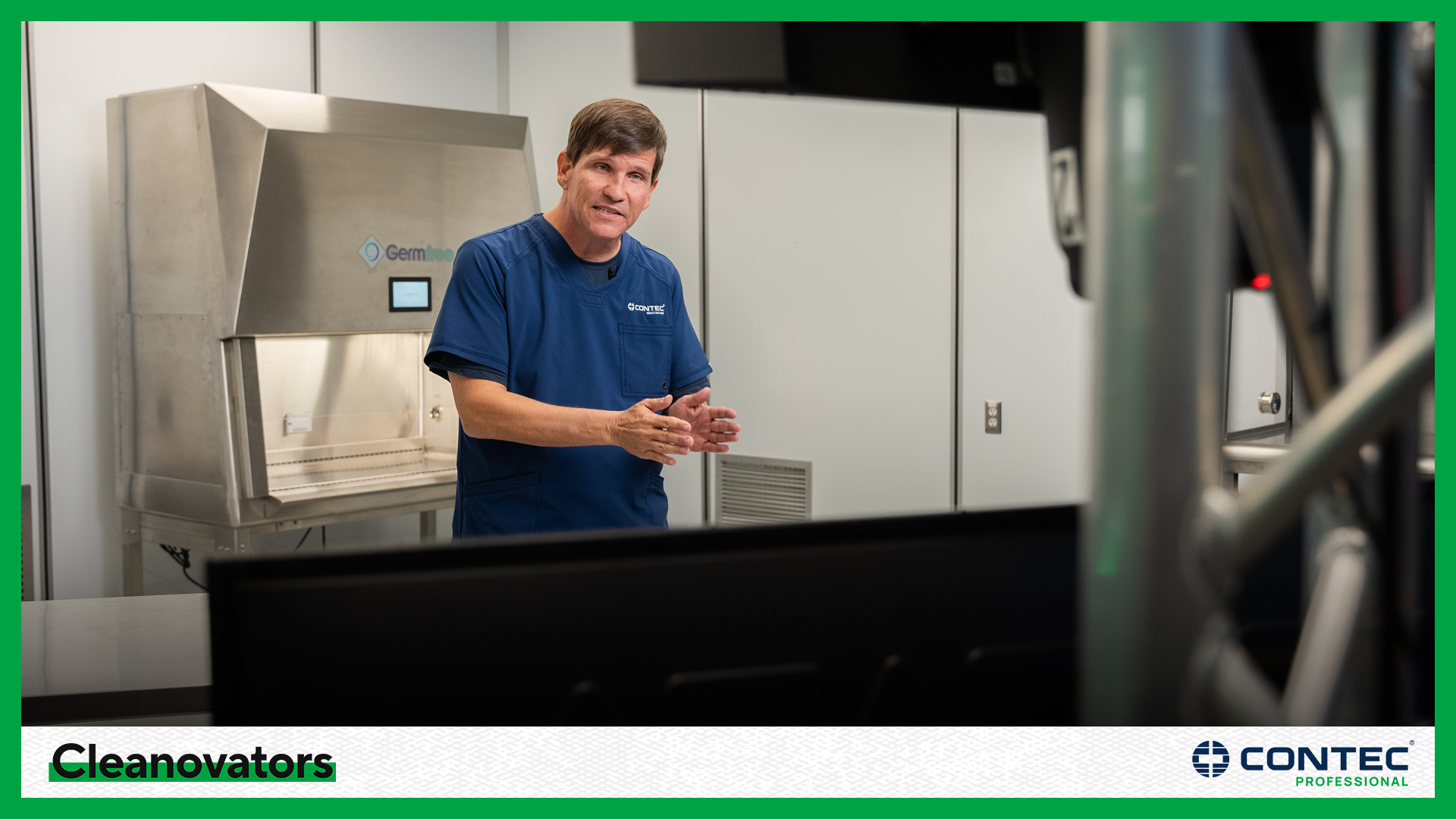
Cleaning a sterile compounding pharmacy is not the same as cleaning any other healthcare environment. In this on-demand webinar, Contec Healthcare Clinical Support Manager Michael Myers breaks down the critical differences, highlighting why Environmental Services (EVS) teams must adopt specialized protocols, tools, and training to meet USP <797> requirements.
From cleanroom design and airflow to disinfectant dwell times and standardized procedures, this session provides practical guidance to help healthcare facilities maintain control, ensure compliance, and ultimately protect patient safety.
Key Takeaways
- A compounding pharmacy is not simply another hospital room. EVS personnel require specialized, documented training before entering and cleaning classified spaces.
- EVS and pharmacy must communicate. Pharmacy leadership and EVS leadership should align on responsibilities, procedures, training, and expectations.
- Cleaning personnel are integral to patient safety. The webinar places their role alongside the engineering controls, pharmacy practices, and healthcare professionals that protect compounded medications.
- Pharmacy-specific tools and procedures matter. Personnel need to know exactly which tools, disinfectants, dwell times, sequences, and techniques apply to each task.
- Visual cleanliness is not enough. Because microbiological contamination cannot be seen with the naked eye, repeatable procedures provide the foundation for confidence in the cleaning process.
- Cleanroom conduct matters. Proper garbing, hand hygiene, controlled movement, and minimizing unnecessary talking all contribute to contamination control.
- Think of disinfection like painting. Handheld wipes address detailed surfaces first, while wall mops provide broader coverage using unidirectional, overlapping strokes.
- Complete coverage is essential. A missed area can become a potential harbor point for contamination.
- Consistency supports a state of control. Different employees should not clean the same environment using entirely different approaches.
- Collaboration begins before EVS enters the pharmacy. Appropriate training and clearly defined responsibilities should be established before personnel are assigned to clean the space.
Featured Presenters
Webinar Section Summaries
Introduction: Why EVS and Pharmacy Collaboration Matters
Michael Myers, Clinical Support Manager with Contec Healthcare, introduces the fundamental difference between cleaning general acute-care areas and cleaning a sterile compounding pharmacy. While EVS personnel may have extensive experience cleaning operating rooms, isolation rooms, patient rooms, or ambulatory surgery centers, that experience alone does not prepare them to enter and clean a compounding pharmacy.
Pharmacy regulations create specialized requirements for how these environments are cleaned and which tools and procedures are used. Myers stresses that EVS personnel may need to approach pharmacy cleaning as if they are starting again from the fundamentals. Communication between pharmacy and EVS is therefore essential so both departments understand their respective responsibilities and requirements.
Understanding the Compounding Pharmacy Cleanroom
The webinar explains the basic operation of a cleanroom. HEPA-supplied air enters through the ceiling, moves through the room, and exits through returns positioned low on the walls. This continuous airflow helps remove dust and small particles while the environment also maintains controlled temperature and humidity.
Personnel entering these environments require specialized PPE, and cleaning and disinfection occur at defined frequencies. Myers notes that ceilings and walls may receive monthly cleaning, while floors and countertops are cleaned daily.
Primary engineering controls (PECs) are particularly important because this is where drug compounding takes place. As a general rule presented in the webinar, PECs are off-limits to EVS and are cleaned by pharmacy personnel. EVS may instead be responsible for areas such as ceilings, walls, floors, and air returns.
Why Cleaning and Disinfection Are Critical to Patient Safety
Cleanroom engineering controls and the aseptic technique practiced by pharmacy technicians are important safeguards, but neither people nor mechanical systems are infallible. Cleaning and disinfection provide another critical layer of protection.
Myers emphasizes that even a state-of-the-art cleanroom staffed by highly qualified healthcare professionals cannot provide confidence in medication safety if the environment is not cleaned correctly.
This is especially important because compounded medications may be injected directly into a patient's bloodstream, bypassing some of the body's natural defenses. The webinar therefore positions cleaning personnel as essential members of the patient-safety process, alongside pharmacy staff, nurses, physicians, and pharmacy leadership.
Training Requirements for EVS Personnel Entering Classified Spaces
Anyone entering a classified pharmacy space must follow the protocols established by that facility. Even an EVS employee entering only to remove trash or clean a floor must receive appropriate training.
The webinar identifies several important training areas:
- Hand hygiene and proper garbing
- Donning and doffing specialized PPE
- Facility-specific cleaning protocols and sequences
- Proper use of pharmacy-specific cleaning tools
- Disinfectant selection and required dwell times
- Conduct within the cleanroom
Cleaning tools used in the pharmacy are described as unique to that environment and stored there rather than being brought in on a typical EVS cart.
Personnel must also understand the chemistry assigned to individual tasks. For example, the webinar notes that daily floor cleaning might use a daily disinfectant, while monthly wall cleaning will generally involve a sporicidal agent.
Cleanroom behavior is another component of training. Personnel should minimize unnecessary talking and move slowly because people themselves generate and disperse particles. All required training must be documented.
Cleaning Frequencies vs. Facility-Specific Procedures
An important distinction in the webinar is that the applicable chapter establishes how frequently certain areas need to be cleaned but does not prescribe exactly how every cleaning task should be performed.
That responsibility falls to the individual facility, which must establish detailed and repeatable procedures.
This level of detail matters because personnel are attempting to remove contamination they cannot see. Myers contrasts bacteria, described as being smaller than half a micron, with the approximately 40–50 micron lower range of what a person can see with the naked eye.
Visual inspection therefore cannot reliably confirm microbiological cleanliness. Instead, facilities need standardized procedures specifying factors such as:
- Tools
- Cleaning chemistry
- Dwell time
- Cleaning sequence
- Direction of cleaning
Myers gives the example of beginning near the primary engineering controls at the back of the room and progressing toward the entrance. If employees use different procedures on different days, the facility cannot have the same confidence in maintaining a microbiological state of control.
Developing a Cleanroom Mindset
One of the unique challenges of cleanroom cleaning is that the environment may already appear exceptionally clean. An employee accustomed to visible soil might enter a bright, clean pharmacy and wonder what actually needs to be cleaned.
Myers calls for a “cleanroom mindset.”
Instead of looking for visible dirt and removing it, personnel must trust their training and systematically execute the established procedure. The goal is contamination control even when the contamination itself cannot be seen.
To make this concept easier to visualize, Myers compares cleanroom disinfection to painting a wall.
“Painting” with Disinfectant: A Practical Cleaning Analogy
When painting a wall, a person typically begins with a small brush to address trim, edges, switches, and other detailed areas. A larger roller is then used to cover the broad surface using overlapping strokes.
The same principle can be applied to cleanroom disinfection.
A handheld wipe serves as the equivalent of the trim brush. Personnel first address smaller and irregular surfaces such as exit signs, light switches, air returns, and pass-throughs. A wall mop then functions like the larger paint roller, applying disinfectant across the broader wall surface.
Myers emphasizes unidirectional, overlapping strokes and complete coverage. Missing a spot while painting creates a visible imperfection; missing a spot with disinfectant can leave a location where harmful contamination may persist or grow.
Thinking of the task as “painting the cleanroom with disinfectant” gives personnel a practical visualization of the thorough coverage required.
Strengthening Communication Between EVS and Pharmacy
The webinar closes by returning to its primary message: communication between EVS and pharmacy is critical whenever EVS personnel will enter classified spaces.
EVS leadership is encouraged to communicate directly with pharmacy leadership and arrange appropriate training before assigning staff to these environments.
Myers also identifies resources available through Contec Healthcare, including training videos, task sheets, and personnel who can provide facility-based training for pharmacy and EVS teams.
The overall goal is to ensure that EVS personnel understand the specialized requirements of pharmacy environments before they are responsible for cleaning them.
 return to overview
 back to top