Why Sustainable EVS Programs Start with Smarter Cleaning Systems—Not Just Greener Products
Why Sustainable EVS Programs Start with Smarter Cleaning Systems—Not Just Greener Products
Healthcare organizations face increasing pressure to reduce their environmental footprint while maintaining the highest standards of cleanliness and infection prevention. From ambitious carbon reduction initiatives to water conservation goals and waste diversion programs, Environmental Services (EVS) leaders are being asked to balance sustainability with operational performance and patient safety.
 Historically, sustainability discussions around cleaning products have focused on a simple question: Is it reusable or disposable?
Today, healthcare leaders are asking a more important question:
What is the total environmental impact of our cleaning program?
The answer requires looking beyond individual products and evaluating the entire cleaning process—from manufacturing and transportation to daily use, maintenance, and disposal.
Why EVS Sustainability Is More Complex Than It Appears
Reusable products are often assumed to be the more environmentally responsible choice. While reuse can reduce waste in many applications, floor care systems present a more complex picture.
Every reusable microfiber mop pad must be:
- Collected after use
- Transported for laundering
- Washed using water and detergents
- Dried using thermal energy
- Returned to the healthcare facility
- Inspected and eventually replaced
Each of these steps consumes valuable resources.
Disposable systems eliminate many of these maintenance activities but generate more solid waste. Determining which system creates the lower environmental impact requires evaluating every stage of the product's life—not just what happens after use.
This is why many healthcare organizations now use Life Cycle Assessments (LCAs) to support sustainability decisions.
What Is a Life Cycle Assessment?
A Life Cycle Assessment (LCA) is an internationally recognized methodology (ISO 14040 and ISO 14044) used to evaluate the environmental impacts of a product throughout its entire lifecycle—from raw material extraction through manufacturing, transportation, use, maintenance, and end-of-life disposal.
Rather than focusing on a single sustainability metric, LCAs evaluate the total resources required to manufacture, operate, maintain, and ultimately dispose of a product.
As Contec Professional's independently reviewed Life Cycle Assessment explains:
"Measuring sustainability from 'cradle to grave' is much more complicated than just perceptions."
This comprehensive approach allows healthcare facilities to make evidence-based purchasing decisions rather than relying on assumptions.
Water Conservation Begins Beyond the Mop Bucket
Water stewardship has become a strategic priority for many healthcare systems. While daily floor cleaning requires relatively little water, reusable microfiber programs introduce another significant source of water consumption: laundering.
Every wash cycle requires:
- Fresh water
- Detergents
- Wastewater treatment
- Rinse cycles
- Additional processing before the mop can be reused
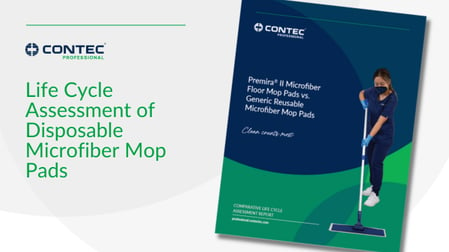 Contec Professional's comparative Life Cycle Assessment found that the maintenance phase—including laundering—was the largest contributor to environmental impacts for reusable microfiber mop systems.
The Life Cycle Assessment evaluated environmental impacts across seven recognized categories:
- Global Warming Potential
- Water Consumption
- Acidification
- Eutrophication
- Smog Formation
- Fossil Fuel Depletion
- Ozone Depletion
For sustainability teams, this reinforces the importance of evaluating resource consumption throughout the cleaning process—not simply the amount of waste generated after use.
The Hidden Energy Cost of Reusable Cleaning Systems
Energy use is another frequently overlooked component of floor care sustainability.
Reusable microfiber systems require repeated laundering, which consumes:
- Electricity
- Natural gas
- Water heating
- Drying energy
- Wastewater treatment
- Labor
According to Contec Professional's ISO-compliant Life Cycle Assessment, laundering was responsible for the greatest environmental impact associated with reusable microfiber mop systems. Across all seven environmental categories studied, the maintenance phase was identified as the largest contributor to environmental burden.
The report concludes:
"Results of the LCA indicate that PREMIRA® II pads have a lower impact on all environmental categories than relaundered mop pads, primarily due to the electricity, thermal energy and wastewater treatment required to effectively launder microfiber mop pads."
These findings illustrate why many healthcare organizations are shifting from evaluating products in isolation to evaluating complete cleaning systems.
Transportation Impacts Extend Beyond Product Delivery
Transportation is often viewed as a one-time shipment from manufacturer to customer. However, reusable cleaning textiles may travel repeatedly throughout their usable life.
Depending on the facility's cleaning program, reusable mop pads may be:
- Delivered to the healthcare facility
- Transported to an off-site laundry
- Returned after cleaning
- Repeated through every laundering cycle
Contec Professional's Life Cycle Assessment found that transporting reusable mop pads to and from an off-site laundry increased Global Warming Potential by approximately 10% compared with on-premise laundering.
Evaluating transportation across the entire lifecycle provides a more complete understanding of a cleaning system's carbon footprint.
Sustainability Doesn't End at Disposal
Many sustainability conversations focus almost exclusively on landfill waste. While waste reduction remains important, disposal represents only one phase of a product's environmental impact.
Lifecycle thinking evaluates:
- Raw material sourcing
- Manufacturing
- Packaging
- Transportation
- Product use
- Maintenance
- End-of-life disposal
Contec Professional's Life Cycle Assessment found that for reusable microfiber systems, the environmental impacts associated with repeated maintenance often exceeded those associated with disposal alone.
The key takeaway is that the most sustainable cleaning system is not necessarily the one that creates the least waste—it is the one that minimizes total resource consumption throughout its lifecycle.
Sustainable Cleaning Must Also Support Infection Prevention
Environmental sustainability should never come at the expense of patient safety.
Healthcare-associated infections (HAIs) continue to affect approximately 1 in 31 hospitalized patients in the United States on any given day, according to the Centers for Disease Control and Prevention (CDC). Effective environmental cleaning remains one of the most important strategies for reducing pathogen transmission.
Single-use microfiber systems can help support infection prevention initiatives by:
- Eliminating risks associated with inadequate laundering
- Providing a clean mop pad for every patient room
- Supporting standardized cleaning processes
- Reducing opportunities for cross-contamination
For many healthcare organizations, sustainability initiatives are increasingly evaluated alongside cleaning effectiveness, operational efficiency, and infection prevention outcomes—not independently of them.
Challenging Traditional Assumptions About Sustainability
For decades, sustainability conversations have centered around the familiar phrase:
Reduce. Reuse. Recycle.
While these principles remain valuable, modern lifecycle assessments demonstrate that reuse alone does not always result in the lowest environmental impact.
Contec Professional's independently verified Life Cycle Assessment compared disposable microfiber mop pads with reusable microfiber mop pads across five lifecycle phases and seven environmental impact categories. The study found that the reusable system's maintenance phase—particularly laundering—was the dominant contributor to environmental impacts.
The report concludes:
"Contrary to the paradigm that 'reduce, reuse, recycle' always creates less environmental impacts than single-use, disposable products, the results of this Life Cycle Assessment clearly indicate that PREMIRA® II microfiber mop pads cause less environmental harm than microfiber mop pads that are reused and relaundered through many cycles."
Rather than relying on assumptions, healthcare organizations can use lifecycle thinking to evaluate the true environmental impact of their cleaning programs.
Looking Ahead: Building More Sustainable EVS Programs
Sustainability in healthcare is no longer measured by a single metric. Modern EVS programs must balance environmental stewardship with infection prevention, operational efficiency, staff productivity, and regulatory expectations.
As hospitals continue pursuing carbon reduction, water conservation, and resource optimization goals, purchasing decisions are increasingly based on measurable lifecycle impacts rather than perceptions.
By evaluating cleaning systems holistically—from manufacturing through end-of-life—EVS leaders can identify solutions that help reduce resource consumption while maintaining the high standards of cleanliness patients expect.
The future of sustainable healthcare cleaning isn't simply about choosing reusable or disposable products. It's about making informed decisions based on the complete environmental impact of the entire cleaning process.
Frequently Asked Questions
What is a Life Cycle Assessment (LCA)?
A Life Cycle Assessment (LCA) is an internationally recognized methodology (ISO 14040/14044) that evaluates the environmental impacts of a product throughout its entire lifecycle, including raw material extraction, manufacturing, transportation, use, maintenance, and disposal.
Why can reusable microfiber mop systems have a larger environmental impact?
While reusable mop pads reduce solid waste, they require repeated laundering, which consumes water, electricity, thermal energy, detergents, labor, and wastewater treatment resources. These maintenance activities can significantly influence overall environmental impact.
Does choosing disposable microfiber mean sacrificing sustainability?
Not necessarily. Sustainability should be evaluated using a full lifecycle perspective. Independently verified Life Cycle Assessments have shown that some disposable microfiber systems may have a lower overall environmental impact than reusable alternatives due to reduced maintenance requirements.
How can EVS departments improve sustainability without compromising infection prevention?
Healthcare facilities can evaluate cleaning systems using lifecycle data, standardize cleaning processes, reduce unnecessary resource consumption, optimize product usage, and implement evidence-based cleaning protocols that support both environmental goals and patient safety.
Key Take-Aways
-
Sustainability Requires a Lifecycle Perspective
The true environmental impact of a cleaning program extends beyond product disposal. Evaluating water consumption, energy use, transportation, maintenance, and end-of-life management provides a more accurate picture of sustainability. -
Resource Consumption Matters as Much as Waste Reduction
Repeated laundering of reusable cleaning products can significantly increase water and energy use. Modern Life Cycle Assessments help healthcare facilities identify opportunities to reduce overall resource consumption while maintaining cleaning performance. -
Sustainable Cleaning Should Support Both Environmental and Patient Safety Goals
The most effective EVS programs balance sustainability with infection prevention, operational efficiency, and cleaning consistency—helping healthcare facilities meet environmental objectives without compromising patient care.
References
- Centers for Disease Control and Prevention. Healthcare-Associated Infections (HAIs). https://www.cdc.gov/hai/
- U.S. Environmental Protection Agency. Sustainable Materials Management. https://www.epa.gov/smm
- Practice Greenhealth. Environmental Excellence in Healthcare. https://practicegreenhealth.org
- ISO 14040:2006 and ISO 14044:2006. Environmental Management—Life Cycle Assessment.
- Contec Professional. Premira® II Microfiber Floor Mop Pads vs. Generic Reusable Microfiber Mop Pads: Comparative Life Cycle Assessment Report. Independently verified to ISO 14040/14044 standards.