 Contec Professional
 03/25/2026

 EVS,
Healthcare EVS
EVS,
Healthcare EVS
Something Better Is Reaching Higher
A New Standard in High-Surface Cleaning Is Almost Here
Overhead vents. Surgical lights. Exposed piping. Cabinet tops.
These areas directly impact infection prevention, audit readiness, and patient perception. Yet they’re also some of the most physically demanding surfaces your team cleans.
And here’s the reality: expectations around environmental hygiene are only increasing.
According to the Centers for Disease Control and Prevention (CDC), contaminated environmental surfaces can contribute to the transmission of healthcare-associated pathogens, making proper cleaning and disinfection a critical component of infection prevention programs.
High surfaces collect dust. Dust carries microorganisms. And when air flows through vents or around equipment, those particles can redistribute into the care environment.
The question isn’t whether high surfaces should be cleaned.
The question is: Are your tools helping — or holding your team back?
The Physical Reality of Overhead Cleaning
Environmental Services professionals perform physically demanding work every day. The Occupational Safety and Health Administration (OSHA) recognizes that awkward postures, repetitive motion, and overhead work can increase the risk of musculoskeletal strain and injury.
Cleaning above shoulder height — especially with heavy or rigid tools — contributes to fatigue over a full shift. Over time, that fatigue affects:
-
Productivity
-
Consistency in cleaning
-
Staff morale
-
Injury risk
For EVS leaders navigating staffing shortages and retention challenges, ergonomic equipment isn’t a luxury. It’s a strategic decision.
When tools are easier to use, adoption improves. When adoption improves, outcomes follow.
Why High-Surface Cleaning Impacts Patient Experience
Cleanliness isn’t just an infection prevention metric — it’s a perception metric.
The Health Services Research notes that patient perceptions of hospital cleanliness are closely tied to overall satisfaction scores
Ceiling vents layered with dust. Overhead fixtures with visible buildup. Cabinet tops collecting debris. These details may seem minor, but patients and surveyors notice.
EVS teams are on the front lines of protecting both patient safety and facility reputation.
The right tools help make thorough cleaning more achievable — especially in hard-to-reach areas that can easily be overlooked when time is tight.
Built for the Way EVS Actually Works
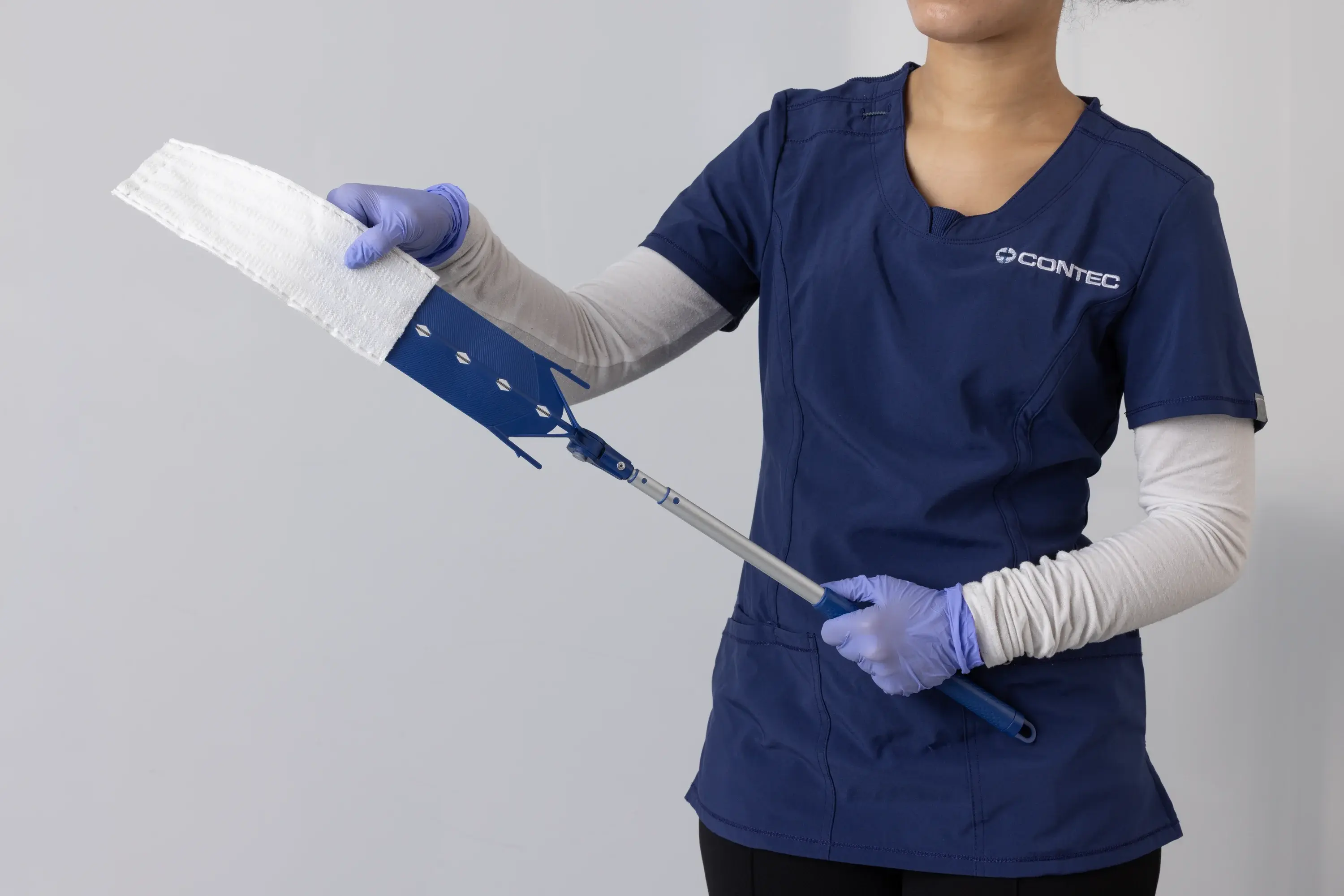
In just a few weeks, we’ll introduce a new High Duster System designed specifically around the realities EVS teams face every day.
This system was developed with a focus on:
-
Lightweight construction to reduce operator fatigue
-
Ergonomic design to support overhead reach
-
Flexible components that conform to irregular surfaces
-
Interchangeable sleeves to address varying soil loads
Because in healthcare environments, one-size-fits-all doesn’t work.
One of the key advantages of the new High Duster LT is its versatility across different cleaning protocols. In critical environments like operating rooms, where AORN guidelines support damp dusting to minimize the spread of contaminants, the system can be paired with the Premira® Original Disposable Microfiber Sleeve to effectively capture and remove particles without dispersing them into the air. In general areas, where efficiency and speed are priorities, teams can switch to a dry dusting approach using the DustMore™ Sleeve, designed to attract and hold dust with ease. This dual capability allows EVS teams to standardize their approach across environments while still aligning with best practices for infection prevention and operational efficiency.
Supporting Compliance and Audit Readiness
Organizations such as The Joint Commission emphasize the importance of maintaining a safe care environment, including environmental hygiene as part of infection prevention efforts
During rounds or surveys, high surfaces are often included in visual assessments. Visible dust accumulation can raise questions — even if other cleaning protocols are strong.
When your tools make it easier to reach, maneuver, and capture dust effectively, your team can clean with greater confidence.
And confidence matters during inspections.
Investing in Your Team
Staffing challenges remain one of the most significant barriers facing EVS leaders today. Retention, engagement, and morale are directly influenced by the resources provided. Providing lightweight, ergonomic tools signals something important:
-
You value your team’s safety
-
You respect their workload.
- You’re committed to helping them succeed.
That investment doesn’t just reduce strain — it strengthens culture. And culture drives performance.
Get Ready to Reach Higher
In three weeks, we’ll officially launch a new High Duster System — built to help EVS professionals clean high surfaces with less strain, greater flexibility, and improved efficiency.
If you’re focused on:
-
Supporting infection prevention initiatives
-
Improving patient satisfaction scores
-
Reducing operator fatigue
-
Equipping your team with tools they’ll actually use
Stay tuned. Because something lighter is about to make a heavy impact.
Frequently Asked Questions
Why is high-surface dusting important in healthcare facilities?
High surfaces such as vents, overhead lights, cabinet tops, and exposed piping can accumulate dust that may harbor microorganisms. The CDC notes that environmental surfaces can contribute to pathogen transmission if not properly cleaned. Routine high-surface dusting supports infection prevention efforts, improves audit readiness, and reinforces patient perception of cleanliness.
How often should high surfaces be cleaned in hospitals?
Cleaning frequency depends on facility risk level, traffic, and infection prevention protocols. Critical areas such as operating rooms and procedure spaces may require more frequent high-surface cleaning compared to administrative or low-risk areas. Always follow your facility’s environmental cleaning policy and infection prevention guidelines.
What are the risks of using heavy or non-ergonomic dusting tools?
Overhead cleaning with heavy or poorly designed tools can contribute to operator fatigue, shoulder strain, and musculoskeletal stress. OSHA identifies awkward postures and repetitive overhead work as ergonomic risk factors. Lightweight, ergonomic tools help reduce strain and improve consistency in cleaning performance.
What features should EVS leaders look for in a high dusting system?
Key considerations include:
-
Lightweight, ergonomic construction
-
Adjustable or flexible head design
-
Compatibility with disposable or microfiber sleeves
-
Ability to reach vents, lights, and irregular surfaces
-
Ease of training and staff adoption
A system-based approach allows teams to adapt tools to different environments and soil loads.
How does high-surface cleaning impact patient satisfaction scores?
Patients often associate visible cleanliness with overall quality of care. Research from AHRQ indicates that hospital cleanliness scores are closely tied to patient satisfaction. Maintaining visibly clean high surfaces supports both perception and compliance efforts.
Is ladder use necessary for effective high dusting?
Not always. Many modern high-dusting systems are designed with telescoping poles and adjustable heads to allow safe reach from the floor. Reducing ladder use can improve safety and workflow efficiency, depending on facility protocols.
 return to overview
 back to top